
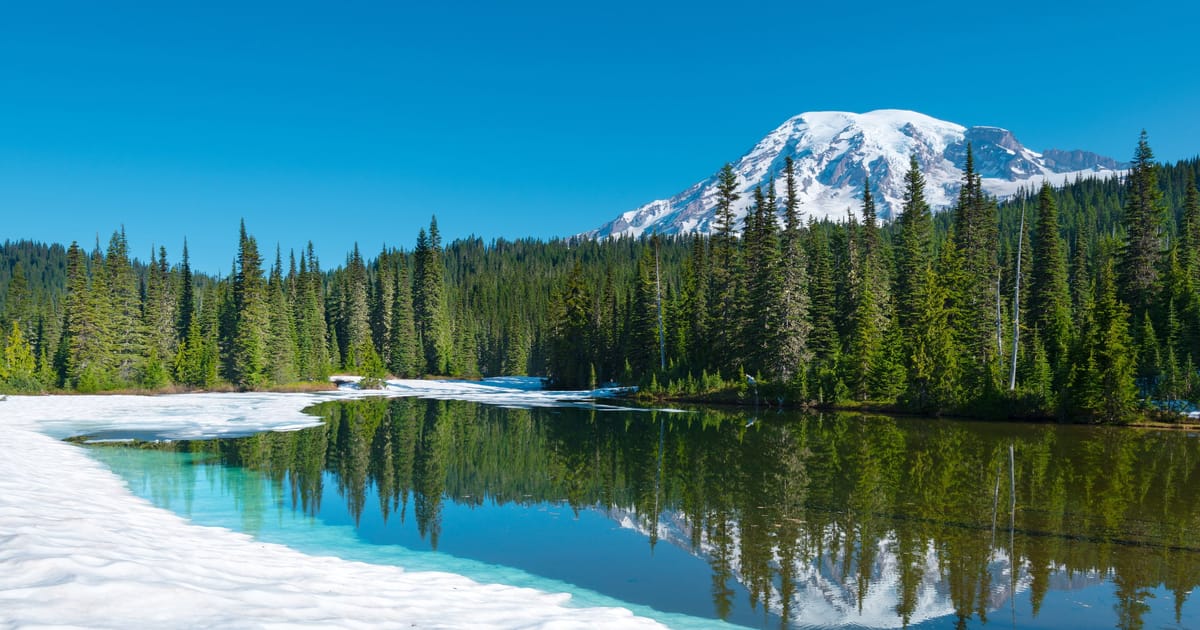
Can you do this?
The Mount Rainier Summit Climb — what it takes
This is real mountaineering — about 9,000 feet of glaciated ascent, crampons and ice axe, roped travel over crevasses, and a 1 a.m. start from high camp for the summit push. It suits fit climbers with glacier-travel, roped-team, and crevasse-rescue skills, or clients on a guided rope, in shape for altitude. It is absolutely not a hike.
- Distance 16 mi
- Time 2–3 days
- Permit Climbing permit required
- Season Late May – Sept
A climbing permit and a climbing cost-recovery fee are required for anyone going above the high camps, and team size and high-camp space are limited. Skills are the harder gate — without glacier travel and crevasse rescue you go with a licensed guide service or you don't go. Weather closes the upper mountain regularly, and turnaround discipline keeps people alive.
The route, in order
How the route runs
Each stop below is a real place on the park's map — walked in sequence, with how long you spend at each.
-
The approach to high camp
From Paradise, climb the Skyline Trail and the Muir Snowfield about 4,600 feet to Camp Muir at 10,080 feet — the standard high camp. A long snow slog with a heavy pack; you arrive, eat, and try to sleep before a midnight wake-up.
- Mount Rainier Standard Summit Route Day 2 (alpine start)
The summit push
Rope up and leave Camp Muir around 1 a.m. across the Cowlitz Glacier and up the Disappointment Cleaver route — crevasses, fixed lines, and the long climb to the 14,411-foot crater rim. Summit early, then the long careful descent all the way back to Paradise.
Before you can go
Permit & logistics
A climbing permit and a climbing cost-recovery fee are required to travel above the high camps; reservable shares via recreation.gov plus walk-up. [VERIFY: current permit reservation window, the cost-recovery fee, and guide-service requirements against NPS Mount Rainier before publishing.]
Plan B
If conditions turn
A multi-day route has more ways to go wrong than a dayhike. Here is what forecloses it — and your move when it does.
- Upper-mountain weather
Storms and high winds shut the route down regularly; the summit is only safely reached in a clear, stable window.
Instead: Build spare days into the trip and turn around without ego — the mountain holds, your safety margin doesn't.
- No glacier skills
Roped glacier travel and crevasse rescue are non-negotiable above Camp Muir.
Instead: Climb with a licensed Rainier guide service, which holds the permits and provides the rope team, or build the skills on a glacier course first.
Make it happen
Reserve your spot
The route is decided. The only thing between you and the trail is the permit — settle it now, while it's fresh.
Save on Entry
One pass covers Mount Rainier — and every other US national park.
The America the Beautiful annual pass pays for itself in two or three park visits. Free entry, free passenger fees, and no more fumbling for a credit card at the kiosk.
 Buy your pass →
Learn more about the pass
Buy your pass →
Learn more about the pass
Ships from US Park Pass. Free shipping in the continental US.