
At a glance
What you’re signing up for
Map
Find it on the map
Honest gut-check
Is this right for you?
Bright Angel is the NPS-recommended inner-canyon trail for a reason. But rim-to-river in a day is a different trip than most visitors have been told — here's the honest version.
Go for it if…
You want Grand Canyon's definitive below-the-rim experience
Bright Angel is the NPS-recommended inner-canyon trail for a reason — water stations, a defined trail, and a clear turnaround ladder. If you're going below the rim for the first time, this is the right trail.
You can plan around a 5–6am start in summer
The heat math requires it. Turning around by 10am from the 3-mile resthouse keeps you above the worst inner-canyon temperatures on the return.
You're OK with significant elevation gain on the return
Rim-to-river and back is a serious undertaking: 4,380 ft of ascent over 4.75 miles, often in heat. Most casual day hikers should plan for the 1.5-mile or 3-mile resthouse, not the river.
Maybe skip it if…
You're planning a rim-to-river day hike in summer
The NPS calls this a "death hike" in summer signage for a reason. Rim-to-river-and-back is a 9.5-mile, 4,380-ft round trip in temperatures that hit 115°F at the river by midday. It's a two-day minimum, and summer is the most dangerous time to try it.
You haven't sorted out water + salty snacks
Water stations at 1.5 miles (May–Sept) and 3 miles (year-round). Between them and the trailhead, you're carrying your supply. The NPS recommends 1 liter per hour below the rim in summer — do the math for your turnaround.
It's after 10am on a hot day and you want to start going down
The hottest inner-canyon hours are 10am–4pm. Starting a below-the-rim hike after 10am in June–August is how most heat rescues begin.
The experience
What it actually feels like
What the descent actually feels like, step by step — from the rim through the geological record to the Colorado River at the bottom.
The trailhead — South Rim, 6,860 ft
Bright Angel Trail leaves the South Rim at 6,860 feet and descends steadily through the canyon's geological record. The first mile is the most-used stretch: paved, wide, and lined with people who've come to see what a mile-deep canyon actually looks like from inside it. The walls start close and the scale registers differently than it does from the rim — that's the point of being here.
- Starts at Bright Angel Trailhead near the South Rim Visitor Center
- Parking is limited — take the free shuttle to the trailhead from the Visitor Center
Water stations — the planning backbone
The water station schedule is the practical schedule for planning your day. From the trailhead to the 1.5-mile station, you carry your own supply. Between stations the pump may or may not be working — always carry more than you think you'll need, and check the NPS Bright Angel page for current station status before your trip.
The NPS rule of thumb: 1 liter per hour below the rim in summer. A 3-mile resthouse turnaround (6 miles RT) takes 3–4 hours. Plan 3–4 liters minimum, and account for the return climb in heat on the ascent.
- 1.5-Mile Resthouse: water available May–September (seasonal pump) <!-- VERIFY -->
- 3-Mile Resthouse: water available year-round (Indian Garden pipeline)
- Indian Garden: water year-round
The descent — what you actually see
The trail cuts through the Kaibab Limestone, Toroweap Formation, Coconino Sandstone, and Hermit Shale on the way down — each layer a different color and texture, laid down over hundreds of millions of years. By the 3-mile resthouse the walls have gone from cream and white above to red and rust below, and the canyon has widened from a slot to a broad plateau.
Indian Garden (4.75 miles) is an oasis in the truest sense — cottonwood trees, a stream, shade structures, and toilets in a canyon that is otherwise pure desert rock. It was a garden tended by the Havasupai for centuries before the park was established. In the morning light before 8am, it's one of the most beautiful places in the canyon.
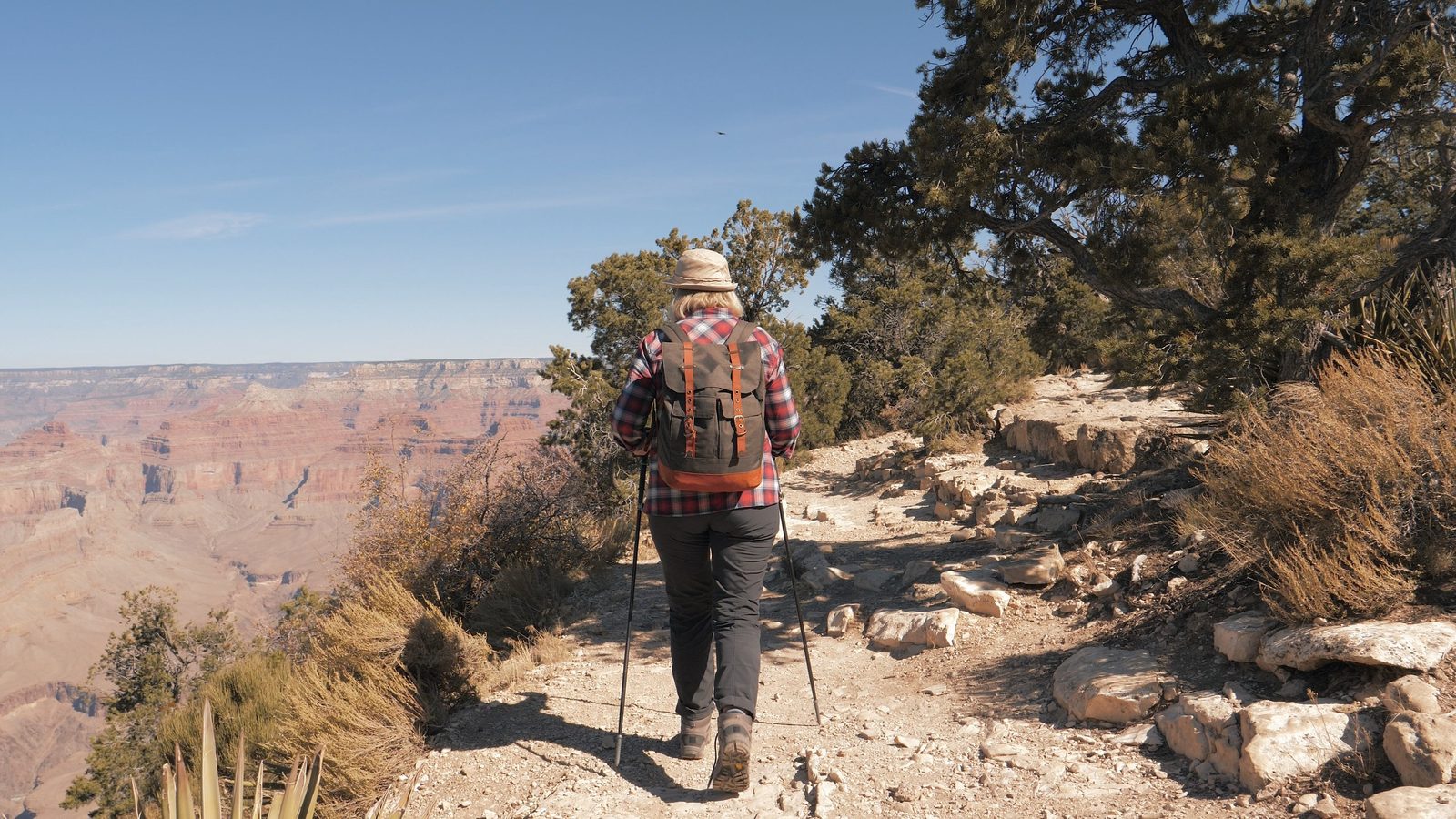
The canyon doesn't look like the photographs until you're inside it. A photograph compresses the layers into a flat image; standing at the 3-mile resthouse, the same walls fill your entire field of vision from the reddish floor below to the white limestone rim 3,000 feet above.
Timing
When to go
Season changes what's safe, not just what's comfortable. The heat math below the rim is real — this table puts it in plain numbers.
- Temps
- 60–85°F rim; 80–100°F canyon floor
- Crowds
- Building
- Shuttle
- Running
- Permit lottery
- No permit required for day hikes
Best combination of temperature and water availability. Water at the 1.5-mile station usually opens in May. Inner canyon temperatures are manageable before noon.
- Temps
- 90°F+ rim; 105–115°F canyon floor
- Crowds
- Peak
- Shuttle
- Running
- Permit lottery
- No permit required
The NPS heat advisory is in force. The 3-mile resthouse is the maximum turnaround for a summer day hike — and only if you started before 7am. Rangers actively turn back hikers after 10am.
- Temps
- 55–80°F rim; 80–100°F canyon floor
- Crowds
- Easing
- Shuttle
- Running
- Permit lottery
- No permit required
October is the sweet spot: cool rim temperatures, bearable inner-canyon heat, and noticeably thinner crowds than September. Water still running at all stations.
- Temps
- 30–55°F rim; 45–65°F canyon floor
- Crowds
- Lightest
- Shuttle
- Limited
- Permit lottery
- No permit required
The upper two miles can ice over and become genuinely hazardous. Microspikes are recommended November–February. Water at 1.5-mile station typically off; carry your full supply. Inner canyon is mild and beautiful.
Gear
What to bring
The short list for a below-the-rim day on Bright Angel — with the reasoning attached, because the why is what makes the difference between a good hike and a heat emergency.
Bring it or turn around
3–4 liters of water per person (summer), 2L minimum (other seasons)
The NPS recommendation is 1 liter per hour below the rim in summer. The inner canyon has no shade between stations. Running out of water on the return climb is the most common cause of heat emergencies on this trail.
Salty snacks — electrolytes, not just sugar
Hyponatremia (low sodium from drinking too much water without salt) is the second-most-common emergency. Trail mix and nuts don't count — bring something with actual salt content.
Stiff-soled trail shoes
The trail is compacted gravel and loose rock on the steeper sections. Sandals and smooth-soled sneakers cause the majority of ankle injuries. Stiff soles and grip matter on the descent, and even more on the ascent.
Bring it and you'll be glad
Wide-brim hat + UPF long-sleeve shirt
The inner canyon has long exposed stretches with no shade from the 3-mile resthouse to Indian Garden. A UPF shirt blocks more UV than sunscreen reapplied once.
Headlamp
A 5am start is the correct call in summer, and a 5am start at Grand Canyon in late June means hiking the first mile in the dark.
Microspikes (winter only)
The upper two miles of Bright Angel can ice completely in December through February. Microspikes are not optional after a freeze; they're the difference between manageable and dangerous.
Leave it behind
Alcohol
Dehydrating in a 110°F environment. Rangers see alcohol as a contributing factor in a disproportionate number of heat rescues.
Heavy camera kit
A phone in a hip pocket manages the heat and the terrain better than a bag full of glass. The shots are there either way.
Backup plans
Always have a Plan B
The heat's up, your turnaround point has passed, or the rim-to-river trip isn't what you planned this time around. Here's what fits instead.
3-Mile Resthouse
3.0 mi · 2 hr · Hard
Why this one Water, shade, toilets, and a dramatic canyon view that most visitors never reach. If you turn around here by 9:30am on a summer day, you're back at the rim before the worst heat.
The turnaround that makes a hard hike manageable — water refill and a rest before the climb back.
South Kaibab to Cedar Ridge
3.0 mi · 2–3 hr · Moderate
Why this one The South Kaibab alternative: 1.5 miles to Cedar Ridge (Ooh Aah Point) for the best open ridge views in the park. No water, shorter, more exposed — but the views are better than Bright Angel at equivalent depth.
No water on South Kaibab — bring enough for the round trip. Best views for the least descent in the park.
Save on Entry
One pass covers Grand Canyon — and every other US national park.
The America the Beautiful annual pass pays for itself in two or three park visits. Free entry, free passenger fees, and no more fumbling for a credit card at the kiosk.
 Buy your pass →
Learn more about the pass
Buy your pass →
Learn more about the pass
Ships from US Park Pass. Free shipping in the continental US.