
At a glance
What you’re signing up for
Map
Find it on the map
Honest gut-check
Is this hike right for you?
The Narrows looks easy in photos and isn’t — it’s miles of wading on footing you can’t see, against a current that decides when the hike is even possible. Here’s the straight version so you can decide before you’re standing in the river.
Go for it if…
You want to hike Zion’s most famous slot canyon
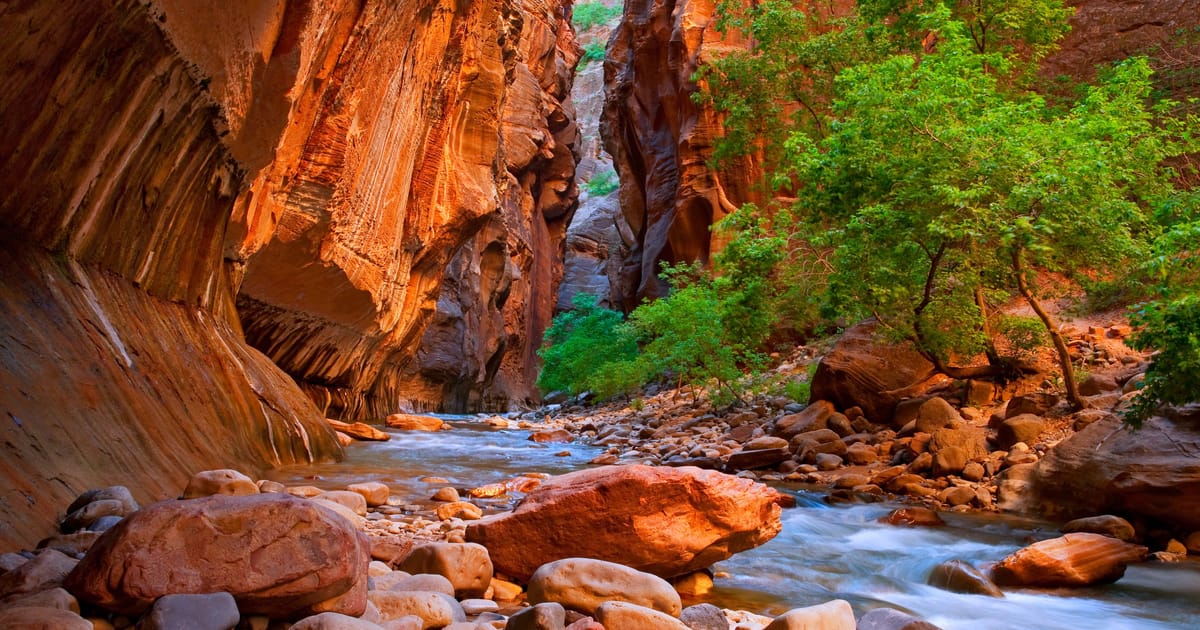
You wade up the Virgin River itself, between sandstone walls that close to 20–30 feet apart in the narrowest stretch.
You’re steady on uneven, underwater footing
Every step lands on cobbles you can’t see clearly, often shin- to thigh-deep, with current pushing against you. A wading stick is most people’s third leg here.
You can turn around on your own clock
It’s out-and-back, so the distance is entirely up to you — most people go an hour or two upriver and come back. No permit, no commitment.
You checked the flow and the flash-flood rating today
The route closes when the river runs high (roughly 150 cfs), and a storm miles away can send a flood down the canyon. The NPS posts a daily flash-flood potential rating — read it that morning.
Maybe skip it if…
The river is high or a flash-flood watch is posted
A narrow canyon is the worst possible place in a flood — there is nowhere to climb to. When the rating is high or the flow is up, the hike is simply off. This is not a judgment call to make in the canyon.
You’re not set up for cold water
Outside high summer the Virgin River is cold enough to bring on hypothermia within a couple of hours. Without a drysuit or wetsuit in the cool months, this is a short paddle to the gateway, not a day hike.
You only have street shoes
Smooth-soled sneakers and sandals slide off wet cobbles. The right footwear is the difference between a great day and a turned ankle two miles from the shuttle.
You want a dry, well-marked trail
There is no trail — the river is the route. If wading through moving water for hours doesn’t sound like your idea of a hike, the paved Riverside Walk gets you to the canyon mouth and back (see Plan B).
The experience
What it actually feels like
Walked through the way a friend who’s done it would tell you — getting in, the wade up to Wall Street, and how far to go, with nothing dressed up and nothing left out.
Getting in — the Riverside Walk to the river gateway
The hike starts dry. From the Temple of Sinawava — the end of the canyon shuttle line — a paved, mostly flat mile follows the river upstream on the Riverside Walk. It’s shaded, gentle, and busy; families and wheelchairs make it this far. Then the pavement simply stops at a gravel bank, the canyon pinches in, and the only way forward is into the water. That first step into the Virgin River is where the Narrows actually begins.
- Starts at the Temple of Sinawava, the last shuttle stop (#9)
- One paved mile to where the pavement ends and the river begins
The wade — Wall Street and the canyon narrowing
The walking is slow and deliberate. You read the water for the shallowest line, plant the wading stick, and shuffle from cobble to cobble; in places the river is ankle-deep, in others it’s up to your waist and you’re leaning into the current. About two miles up, the walls draw in to their tightest — the stretch hikers call Wall Street, where the canyon is a corridor maybe 20 to 30 feet wide with sheer sandstone rising hundreds of feet straight out of the water on both sides. The light goes deep and golden, the air cools, and the river sound bounces off the walls. It is the picture that brought you here, and it earns the wading.
Past Wall Street the crowds thin fast. Most day visitors turn around once they’ve seen the narrowest section, so the upper river — toward Big Spring — is quieter, with deeper pools and stretches where you may have the canyon to yourself for minutes at a time.
There is no trail here — the river is the trail. You’re standing shin-deep in cold, moving water, reading the current for your next foothold, with a thousand feet of sandstone leaning over you on both sides.
Timing
When to go
Season decides almost everything here — water temperature, river flow, flash-flood risk, and whether the route is open at all. Scan across and pick your window.
- Temps
- Water 45–55°F
- Crowds
- Building
- Shuttle
- Running
- Permit lottery
- No permit (bottom-up day hike)
Snowmelt drives the river high — the Narrows is frequently closed in late spring and early summer when flow runs above the ~150 cfs threshold. Cold water demands a drysuit even when it’s open.
- Temps
- Water 60–68°F
- Crowds
- Peak
- Shuttle
- Running
- Permit lottery
- No permit (bottom-up day hike)
The warmest water of the year and no drysuit needed — but July through September is monsoon season, and a thunderstorm miles upstream can send a flash flood down the canyon. Hike early and read the flash-flood rating every day.
- Temps
- Water 55–62°F
- Crowds
- Easing
- Shuttle
- Running
- Permit lottery
- No permit (bottom-up day hike)
Lower, stabler flow than spring, water still tolerable, monsoon season winding down, and thinning crowds — early fall is the most forgiving window of the year for the bottom-up hike.
- Temps
- Water 35–45°F
- Crowds
- Lightest
- Shuttle
- Limited — private cars often allowed
- Permit lottery
- No permit (bottom-up day hike)
The river is dangerously cold — a drysuit is not optional, and hypothermia is the real hazard, not the distance. Beautiful and nearly empty, but only for those properly outfitted.
River conditions change daily — flow, flash-flood potential, and recent closures. Check the morning of before you drive out: See AllTrails conditions
Gear
What to bring
Short list, with the reasoning attached — because on this hike the right footwear and a wading stick are the difference between a great day and a turned ankle miles from the shuttle.
Bring it or turn around
Canyoneering boots + neoprene socks
Closed boots with sticky soles over neoprene socks are what make hours on slick, cold cobbles possible. Street shoes slide and bare feet go numb. Rent the pair in Springdale if you don’t own them.
A wading stick
A sturdy pole is your third point of contact against the current and on footing you can’t see. Most people who try the Narrows without one wish they hadn’t. Outfitters rent them with the boot package.
A drysuit (cool months) or warmth you can swim in
Outside high summer the water is cold enough to bring on hypothermia. A rented drysuit turns winter and shoulder-season wading from dangerous to comfortable. In summer, quick-dry layers are enough — never cotton.
Bring it and you’ll be glad
A dry bag
Phones, keys, and snacks all end up underwater eventually here. A small roll-top dry bag keeps the day’s essentials and your camera safe through the deeper crossings.
Trekking pole (if you skip the rental stick)
A collapsible pole does the wading-stick job in a pinch — bring at least one for balance against the current.
Salty snacks and water
Wading is more work than it looks, and the river water is not drinkable. Carry your own and eat on the gravel bars where you can sit.
Leave it behind
Cotton anything
Cotton holds cold water against your skin and never dries — it’s the fastest route to a miserable, chilled hike. Synthetics or wool only.
Heavy camera gear without waterproofing
Anything not in a dry bag is one slip from the river. A phone in a waterproof pocket captures Wall Street just fine.
Backup plans
Always have a Plan B
The river doesn’t always cooperate — high flow, a flash-flood watch, water too cold for your setup. Find your reason below; each one has a Zion hike worth the drive.
Riverside Walk
2.2 mi · 1 hr · Easy
Why this one The paved approach to the Narrows is a fine destination on its own — flat, shaded, and river-cooled, ending right where the canyon pinches in and the water begins.
Same shuttle stop, same start, but you stay dry. You reach the river gateway and the canyon walls without setting foot in the current.
Emerald Pools
1–3 mi · 1–2 hr · Easy–Moderate
Why this one Shaded, water-themed, and entirely above the river — waterfalls and pools that stay open when the Narrows can’t.
A network of short loops to the Lower, Middle, and Upper pools. Pick your distance; all of it keeps you near water and out of the flood path.
Save on Entry
One pass covers Zion — and every other US national park.
The America the Beautiful annual pass pays for itself in two or three park visits. Free entry, free passenger fees, and no more fumbling for a credit card at the kiosk.
 Buy your pass →
Learn more about the pass
Buy your pass →
Learn more about the pass
Ships from US Park Pass. Free shipping in the continental US.