
At a glance
Thor's Hammer at a glance
Map
Find it on the map
Honest gut-check
Is this the right stop for you?
Thor's Hammer is Bryce's most-photographed formation. Here's how to decide whether to see it from the rim, from below, or both.
Go for it if…
You want Bryce Canyon's best-known hoodoo image
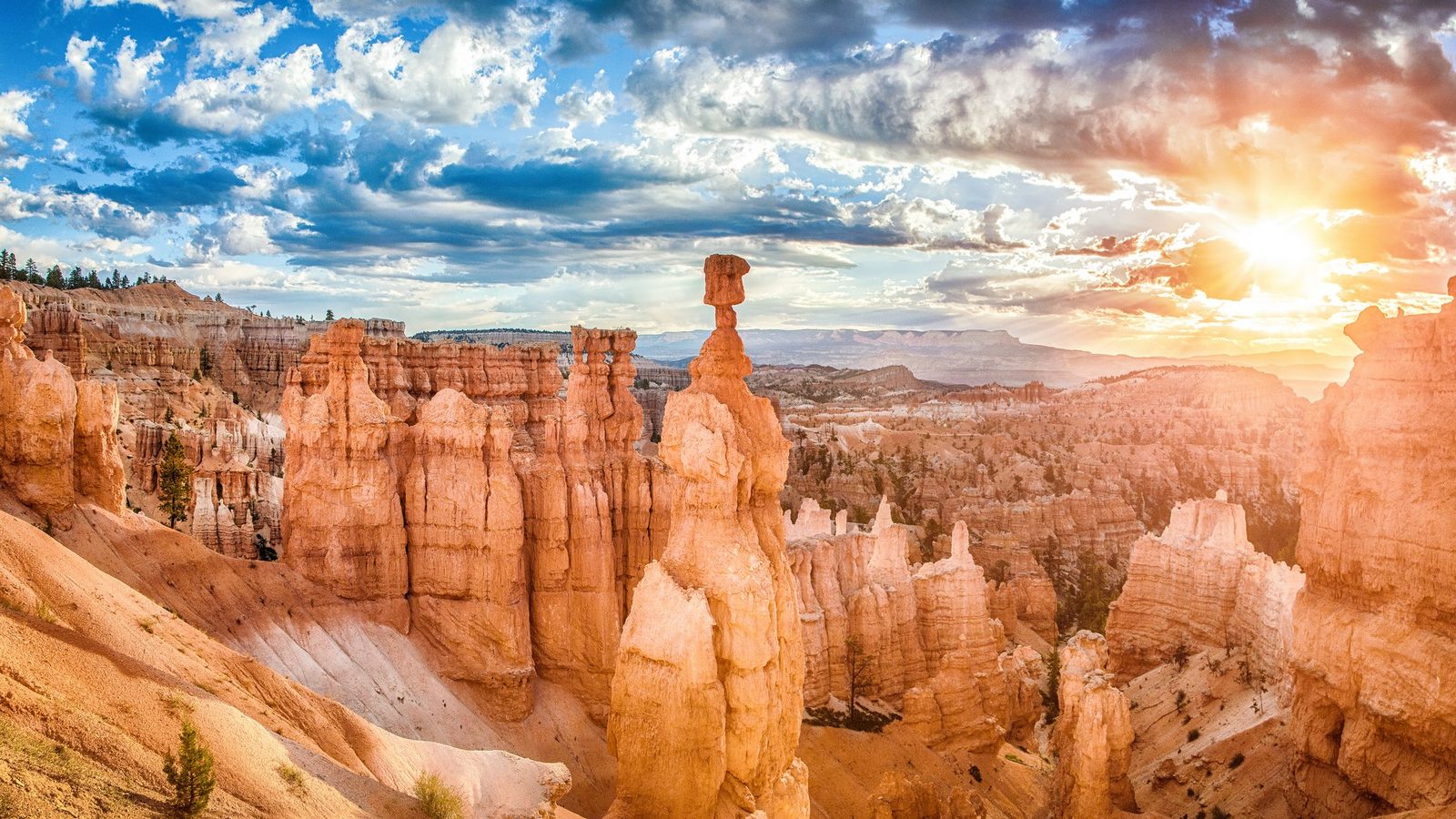
Thor's Hammer appears on virtually every Bryce photo — the alone-standing spire with a flat caprock balancing on top, lit orange and pink at sunrise. Sunset Point delivers it in 10 minutes from the parking lot.
Sunrise photography is your reason for being here
First light hits the amphitheater from the east. At sunrise, Thor's Hammer glows deep orange while the canyon behind it is still blue-grey. The window lasts about 20 minutes before the full sun flattens everything.
You want to see it from above AND from below
Sunset Point gives you the rim view; the Navajo Loop Trail descends 521 feet into the amphitheater and passes directly beside it. Two different perspectives on the same formation.
You're short on time but want the park's signature view
Ten minutes from the car to the overlook. You can be standing at the rim with Thor's Hammer in front of you faster than almost any other "wow" stop in the Utah parks.
Maybe skip it if…
You're already planning the Navajo Loop hike
You'll see Thor's Hammer from below and at eye level on the hike — a better angle than the rim overlook for a fee of 2.9 miles and 521 feet of descent. No need to also do the rim stop.
Midday light in summer
Bryce's hoodoos look flat under high overhead sun. The orange and pink colors that make Thor's Hammer famous require angled light — early morning or late afternoon.
You need solitude for the experience
Sunset Point is Bryce's most visited viewpoint. At sunrise and sunset it can hold dozens of photographers. The rim path is wide and the view isn't blocked by crowds, but it isn't quiet.
The experience
What you'll see
Two very different perspectives on the same formation — one from 150 feet above, one from the amphitheater floor directly beneath it.
From the rim — Sunset Point
Walk 0.2 miles east along the paved rim trail from the Sunset Point parking lot and the formation is directly below you. Thor's Hammer is the narrow sandstone spire with the flat, harder capstone on top — the cap protected it from rain erosion that stripped the surrounding hoodoos to shorter, more tapered shapes. It sits in the center of the amphitheater, alone and unmistakable.
The amphitheater below is densely packed with hoodoos — hundreds of them in orange, cream, and red, extending in every direction. Thor's Hammer reads clearly above the others because of its height and the distinctive hammer shape. At sunrise the entire basin glows; at sunset the western-facing hoodoos catch the orange light while the east side falls into shadow.
- Thor's Hammer stands approximately 150 feet tall from the amphitheater floor
- Sunset Point at 8,000 ft elevation — noticeably cooler than the desert floor
From below — the Navajo Loop descent
The Navajo Loop Trail descends from Sunset Point into the amphitheater and passes directly beside Thor's Hammer at the bottom of Wall Street — a narrow canyon between towering fin walls. At that point you're standing on the amphitheater floor looking up at the formation from about 150 feet below, with the hoodoos packed in close on either side. The proportions are completely different from the rim view.
The descent is steep and sustained — 521 feet in under a mile, on switchbacks cut into the rock face. Going down is straightforward; the climb back out is the effort. Most people take 1.5–2 hours for the full loop. Note that one arm of the Navajo Loop through Wall Street sometimes closes in winter when ice on the switchbacks makes the descent dangerous — check NPS.gov for current conditions before you go.
- Navajo Loop: 2.9 mi · 521 ft descent · Moderate · 1.5–2 hr
- Wall Street narrows put you at eye level with the spire
From the rim, it looks like a toy: perfectly proportioned, balanced impossibly. From the amphitheater floor, it fills the sky above you. Same formation, two completely different scales.
Timing
When to visit
Light angle and temperature define the experience at 8,000 feet. Here's how each season plays.
- Temps
- 40–65°F at the rim
- Crowds
- Building
- Shuttle
- Seasonal shuttle begins in spring — check NPS.gov
- Permit lottery
Late snow can still dust the hoodoos in April — red and white together is worth the cold. Crowds are lower than summer. Navajo Loop is fully open most years by mid-May.
- Temps
- 55–80°F at the rim
- Crowds
- Peak
- Shuttle
- Shuttle required to access Sunset Point from Bryce Canyon City
- Permit lottery
Bryce Canyon sits at 8,000+ feet — it's cooler than the desert floor but still busy. Shuttle is the only way in during peak hours. Sunrise slot fills fast. Midday is flat light and wall-to-wall people at the rim.
- Temps
- 35–65°F at the rim
- Crowds
- Thinning
- Shuttle
- Shuttle schedule reduces after Labor Day
- Permit lottery
Comfortable temperatures, no shuttle requirement (you can drive to the lot), and the amphitheater has some of its most dramatic light as the sun angle drops. October sunrises are exceptional.
- Temps
- 10–40°F at the rim
- Crowds
- Minimal
- Shuttle
- No shuttle in winter
- Permit lottery
Snow turns the amphitheater into a black-and-white photograph with the orange hoodoos breaking through. The rim trail may be icy — traction devices recommended. Wall Street section of Navajo Loop often closes in winter; check before descending.
Gear
What to bring
The rim is cooler and drier than you expect. A short list, but the elevation is real.
Worth carrying
Warm layer
The rim sits at 8,000+ feet. It can be 20 degrees cooler than Bryce Canyon City or the valley below. Early-morning visitors in summer are often surprised by how cold it is before the sun crests the plateau.
Water — 1 liter minimum
High elevation, dry air. Even a short morning at the rim at altitude dehydrates you faster than you expect. Increase this significantly if you're doing the Navajo Loop descent.
Traction devices in winter/spring
The paved rim trail and the Navajo Loop switchbacks ice over in cold weather. Microspikes are not optional when ice is present.
Leave it behind
Trekking poles for the rim overlook
The 0.2-mile rim walk doesn't need them. If you're doing the Navajo Loop, poles help on the descent.
Backup plans
Other options
If Sunset Point is packed, or you want more than one angle on the hoodoos.
Bryce Point
0.1 mi from parking · rim overlook · no descent
Why this one A wider, higher overlook over the densest concentration of hoodoos in the park. Bryce Point takes in the full amphitheater sweep including the area where Thor's Hammer stands, with more elbow room than Sunset Point.
At the end of a 2-mile spur from the main scenic drive. Sunrise is as dramatic here as at Sunset Point — and usually less crowded.
Inspiration Point
Short walk from parking · tiered overlooks
Why this one Three separate levels of overlook, each with a different angle on the Silent City hoodoo field. Less crowded than Sunset Point and within a short walk of the lot.
The upper level is the highest public vantage point over the main amphitheater.
Save on Entry
One pass covers Bryce Canyon — and every other US national park.
The America the Beautiful annual pass pays for itself in two or three park visits. Free entry, free passenger fees, and no more fumbling for a credit card at the kiosk.
 Buy your pass →
Learn more about the pass
Buy your pass →
Learn more about the pass
Ships from US Park Pass. Free shipping in the continental US.